

California personal injury law is the body of state civil law that governs how harm is evaluated when an injury is caused by another person’s or entity’s conduct. It establishes who is legally protected, how responsibility is assessed, what standards apply to fault, and how compensation is calculated when liability is proven. These rules apply statewide and are based on defined legal principles rather than local custom, firm practices, or informal expectations.
This guide explains how California personal injury law functions across its full lifecycle. It outlines the legal rights that arise after an injury, the structure of the claims process, and how compensation is evaluated under state law. The focus is informational only. It does not offer legal advice, recommend action, or address any specific incident. Instead, it provides a clear, structured explanation of how California evaluates injury claims, where discretion exists, and where outcomes depend on documented facts and legal standards.
What Personal Injury Law Means in California
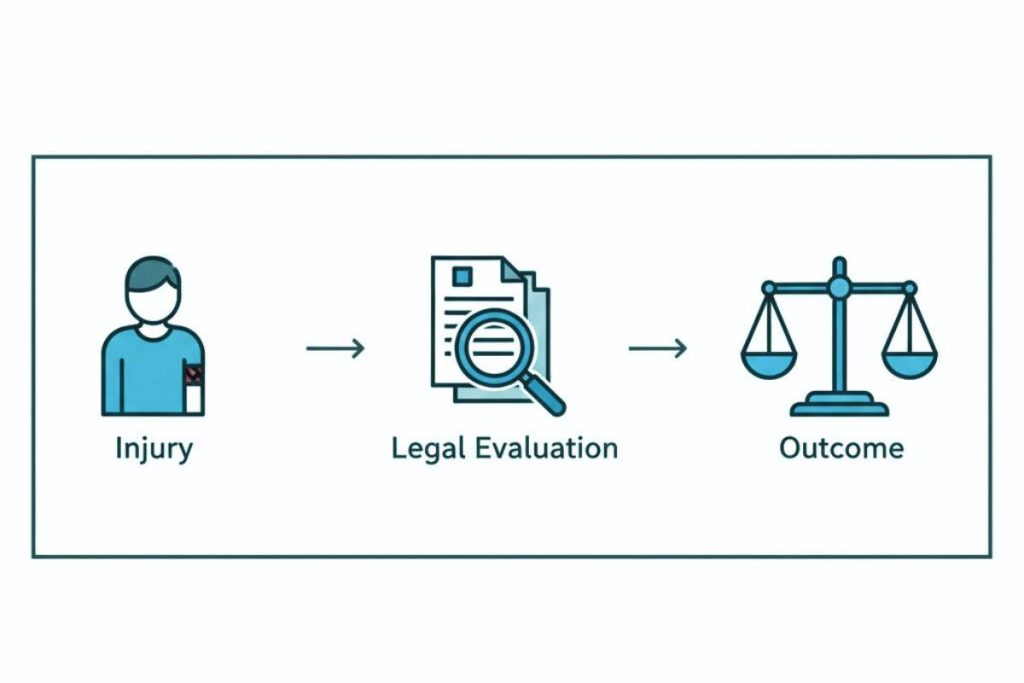
California personal injury law has a specific legal meaning. It is not a general promise of compensation and it is not a measure of fairness. It is a civil law framework that explains when an injury caused by another person or entity can be evaluated under defined legal standards. Understanding that boundary matters, because many injuries never become legally actionable, even when the harm itself is real.
What is the legal foundation of personal injury claims in California?
Personal injury claims in California are based on civil liability for harm caused by another party’s conduct.
These claims arise when an injury is alleged to have resulted from negligence, recklessness, or intentional misconduct. California courts evaluate them using established legal standards, not personal expectations or moral judgments, and they are resolved through the civil court system rather than the criminal system.
At the core of every personal injury claim are four legal elements that must work together. A duty must have existed under the circumstances, meaning the other party was legally required to act with reasonable care. A breach must then be shown, demonstrating that this duty was not met. Causation connects that breach to the injury itself, rather than to coincidence or unrelated factors. Finally, damages must be established, referring to legally recognizable harm such as medical expenses, lost income, or other measurable losses.
If any one of these elements cannot be proven, California law does not treat the claim as legally actionable, regardless of how serious the injury may feel to the person affected.
Personal injury law is also separate from criminal law. Civil claims address financial responsibility for harm. Criminal cases address violations of penal statutes and are brought by the state. An incident may involve both systems, but each follows its own rules and produces different outcomes.
Who does California personal injury law protect?
California personal injury law applies to people injured within the state, regardless of residency.
Protection is not limited to California residents. Visitors and out-of-state individuals may also fall within the scope of California law when the injury occurs in California and state jurisdiction applies.
The law also accounts for people who cannot assert claims on their own. Minors may have claims brought on their behalf by a parent or legal guardian. Legally incapacitated adults may be represented through conservators or other court-recognized representatives.
Immigration status is not a factor in determining whether a personal injury claim can be evaluated.
California courts focus on liability, causation, and damages. Citizenship or immigration classification does not determine whether a claim can be reviewed under the law.
In cases involving fatal injuries, the law allows certain estates and surviving family members to pursue claims through separate legal frameworks. These follow different rules and are evaluated differently from non-fatal injury claims, which is why they are addressed only at a high level here.
What does California personal injury law cover and not cover?
California personal injury law governs civil claims seeking monetary compensation for harm.
It applies when an injured person alleges that another party bears legal responsibility and seeks compensation through the civil legal system.
It does not determine criminal guilt or punishment.
Criminal responsibility is decided under a separate legal process with different standards and consequences.
It does not replace workers’ compensation systems.
Injuries arising out of employment are often governed by California’s workers’ compensation laws, which follow a distinct statutory framework and may limit or exclude civil claims in certain situations.
It does not guarantee compensation.
Personal injury law explains how claims are evaluated, not how they resolve. Outcomes depend on evidence, legal standards, and how specific facts are proven within the framework of California law.
The Legal Sources That Govern Personal Injury Law in California
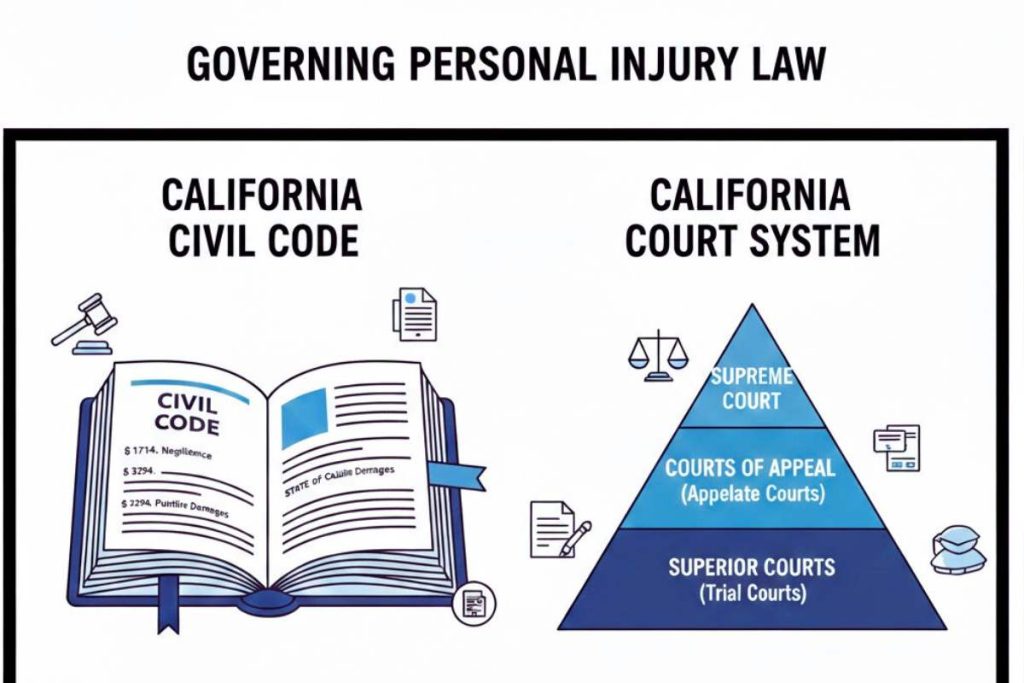
California personal injury law is not created by a single rule or institution. It is formed through a combination of statutes enacted by the state legislature, procedural rules that control how claims move through court, and judicial interpretation that applies those rules to real disputes. Understanding these sources helps explain why injury claims are evaluated based on legal standards and evidence, rather than expectations about fairness or outcome.
Does the California Civil Code define negligence and liability standards?
Yes. The California Civil Code is the primary statutory source for negligence and liability principles used in personal injury cases.
The Civil Code establishes the legal duty of care that individuals and entities owe to others. This duty requires conduct that meets a reasonable care standard under the circumstances, as defined through statutory language and court interpretation.
Fault-based liability is the default framework under California law. A person or entity is legally responsible only when evidence shows that a duty of care existed, that the duty was breached, and that the breach caused harm. These standards are rooted in the Civil Code and applied through fact-specific analysis rather than assumptions about blame.
In limited and clearly defined situations, California law applies strict liability, where responsibility does not depend on proving negligence. When strict liability applies, the legal focus shifts away from conduct and toward responsibility imposed by statute or long-standing case law.
Does the California Code of Civil Procedure control claim timing and process?
Yes. The California Code of Civil Procedure governs how and when personal injury claims proceed through the civil court system.
This body of law establishes filing requirements, service rules, and procedural steps that apply once a claim enters court. These rules operate separately from the legal standards used to determine liability and damages, but they directly affect whether a claim can be heard.
Timing requirements are a central part of this framework. The Code of Civil Procedure sets deadlines that may limit or bar a claim if they are not met. Courts generally enforce these deadlines regardless of the seriousness of the injury or the strength of the underlying facts.
The Code also defines jurisdiction and venue rules. These determine which court has authority over a claim and ensure that cases are heard in the proper forum under California law.
How do California courts and jury instructions shape injury claims?
California courts determine how personal injury law is interpreted and applied in individual cases.
Judges interpret statutes, resolve legal disputes, and manage the procedural course of a case. When a case is tried before a jury, jurors decide factual issues such as fault and damages based on the evidence presented.
California relies on standardized civil jury instructions to guide this process. These instructions explain legal standards in plain language and tell jurors how to apply the law to the facts they find credible. The instructions are designed to shape legal evaluation, not emotional response, which is why they play a significant role in how injury claims are decided.
Court decisions also influence how personal injury law develops over time. Prior rulings may guide interpretation, but outcomes remain highly dependent on the specific facts and evidence of each case rather than precedent alone.
Does federal law ever affect California personal injury claims?
Yes, but only in specific and limited circumstances.
Federal law may intersect with California personal injury cases in areas such as commercial trucking, maritime activity, or aviation, where federal regulations govern certain conduct or safety standards.
Even in these situations, California law generally governs injury recovery. State law controls how damages are evaluated and how compensation is pursued unless a federal statute explicitly provides otherwise. Whether federal law plays a role depends on the facts of the incident and the parties involved.
Your Legal Rights After an Injury in California
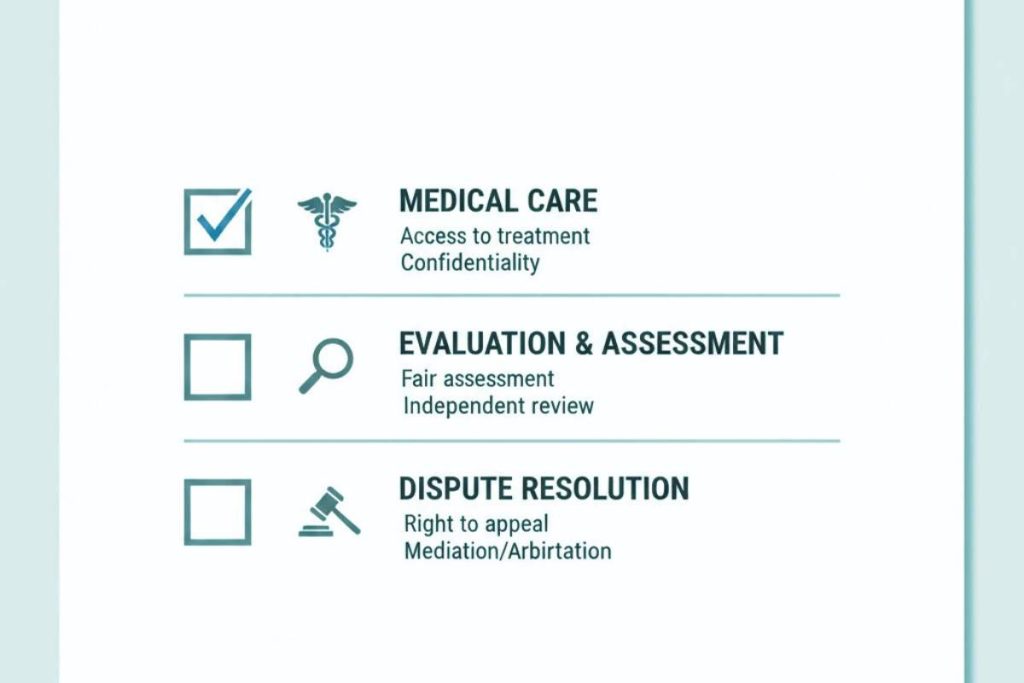
After an injury, California law does not begin by determining outcomes or assigning value. It begins by defining what can be evaluated under the law and what cannot. Legal rights establish the boundaries of that evaluation. They determine which losses may be considered, how medical care fits into the process, and how disagreements with insurers are addressed within the legal framework.
Do injured people have the right to pursue compensation under California law?
Yes. California law allows injured individuals to pursue compensation for legally recognized losses when liability is established.
Compensation is evaluated based on defined categories of harm and the evidence supporting them. It is not automatic and it is not unlimited.
California law recognizes several categories of damages.
- Economic damages involve measurable financial losses, such as medical expenses or lost income, that can be documented and quantified.
- Non-economic damages address non-financial harm, including pain, emotional distress, or loss of enjoyment of life, which are evaluated using legal standards rather than invoices.
- Punitive damages are available only in limited circumstances and require proof beyond ordinary negligence. They are not a routine component of personal injury claims and are subject to specific statutory and evidentiary thresholds.
Whether compensation is available, and in what amount, depends on how these categories are supported by admissible evidence and applied under California law.
Can someone seek medical care without waiting for a claim to resolve?
Yes. California law does not require an injured person to delay medical treatment while a claim is pending.
Medical decisions are separate from the legal process and are generally based on clinical need rather than claim status. Treatment may occur before any settlement discussion or court resolution.
Medical documentation plays a factual role in this process. Records created during treatment establish diagnosis, progression, and response to care. They provide contemporaneous evidence rather than retrospective explanation.
When injuries involve ongoing care or anticipated future treatment, California law allows those needs to be evaluated as part of a claim, provided they are supported by appropriate medical opinion and documentation.
Are injured individuals entitled to fair treatment during the insurance process?
Yes. California law provides protections during the insurance claims process, though it does not eliminate disagreement.
An injured person is not legally required to accept an early settlement offer. Offers made early in a claim may precede a full understanding of injury extent, and acceptance remains voluntary.
Insurer requests are governed by policy terms and applicable law. While insurers may request information relevant to evaluating liability and damages, those requests must relate to the claim and comply with legal standards. Requests outside that scope may be disputed.
Disagreements over fault or valuation are permitted under California law. Injured individuals have the right to challenge how responsibility is assigned and how losses are assessed. These disputes are resolved through evidence and legal process rather than assumption or pressure.
The California Personal Injury Claims Process Step by Step
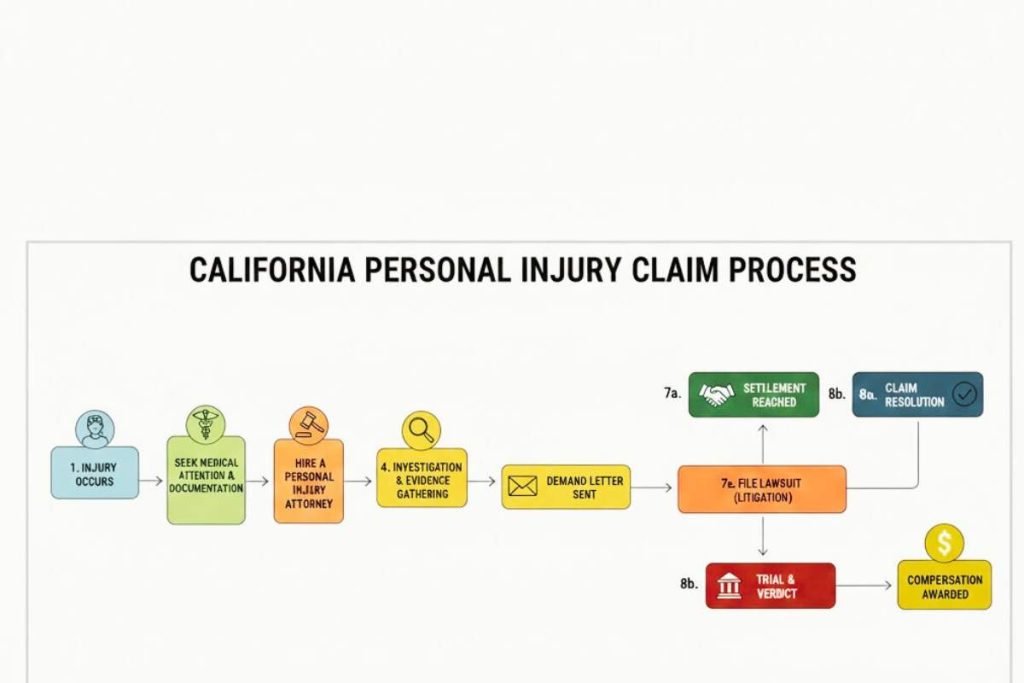
California personal injury claims follow a defined legal sequence. That sequence does not determine outcomes, but it does control how information is gathered, evaluated, and challenged over time. Understanding the structure of the process helps explain why claims develop gradually and why early assumptions often change as facts are documented and reviewed under legal standards.
What immediate legal and medical steps matter after an injury?
Medical needs take priority, but early documentation can affect how a claim is later evaluated.
Emergency or urgent medical care comes first. California law does not require injured individuals to delay treatment for legal reasons, and early care focuses on health rather than claims. At the same time, initial medical records often become the starting point for later legal evaluation because they document injury timing and condition.
Reporting the incident, whether to law enforcement, property owners, or other responsible parties, helps establish when and how the event occurred. Reports do not decide fault, but they often shape the factual timeline that is later reviewed.
Evidence preservation matters because conditions change. Physical scenes, witness availability, and digital records may not remain accessible. Photographs, contact information, and contemporaneous notes help preserve facts that cannot always be reconstructed later.
How does insurance notification and early claim handling work?
Most claims begin with notice to one or more insurance carriers.
Liability insurance is typically notified based on who may be legally responsible for the injury. This notice opens a claim and assigns an adjuster to gather information and begin evaluation.
Additional coverage may also be relevant depending on the facts. Uninsured or underinsured motorist coverage and medical payments coverage can apply independently of fault, subject to policy terms. These coverages do not replace liability analysis, but they may affect how medical expenses or losses are initially addressed.
Early claim handling generally involves claim setup, information requests, and preliminary review. At this stage, insurers are assembling facts rather than determining final responsibility or value.
Why do medical treatment and recovery timelines matter?
The progression of medical treatment affects how injuries are assessed under California law.
Courts and insurers evaluate not only diagnosis, but also response to treatment and recovery over time. This helps distinguish temporary conditions from lasting impairment.
Future care considerations arise when injuries require continued treatment or monitoring. These needs must be supported by medical opinion rather than assumption or projection.
There is also risk in resolving a claim before recovery stabilizes. Maximum medical improvement refers to the point at which further significant recovery is not expected. Evaluations made before that point may not reflect the full scope of injury or future care needs.
How is fault proven under California law?
Fault must be established through evidence, not inference.
Evidence may include medical records, incident reports, photographs, and other documentation connecting conduct to injury.
Witness statements can clarify disputed events. Their relevance depends on credibility, consistency, and proximity to the incident.
In more complex cases, expert testimony may be used. Experts do not decide fault, but they may explain technical issues such as accident mechanics, medical causation, or future care to support legal evaluation.
What is included in a demand package and how do negotiations unfold?
A demand package presents the factual and legal basis of a claim in a structured format.
It commonly includes an incident summary, liability explanation, medical documentation, and a statement of claimed damages. Its purpose is to organize evidence for review, not to predict outcomes.
Negotiations typically unfold in stages. Insurers review the materials, request clarification, and reassess valuation as information develops.
Delays or denials may occur for several reasons, including disputed liability, incomplete documentation, or differing interpretations of damages. These responses reflect disagreement within the process rather than final conclusions.
What happens if settlement does not occur?
Filing a lawsuit is one procedural option when disputes remain unresolved.
A lawsuit begins with a complaint and service of process, formally bringing the dispute into court.
The case then enters discovery, where parties exchange information, take depositions, and request documents to clarify factual issues.
Pre-trial motions may address legal questions before trial. These motions shape what issues proceed but do not resolve factual disputes.
How do personal injury claims ultimately resolve?
Claims may resolve through settlement, mediation, arbitration, or trial.
Settlement can occur at various stages, including after litigation begins. Mediation and arbitration offer structured alternatives to trial, each with different levels of formality and confidentiality.
Trials involve public proceedings, higher cost, and greater uncertainty, but they provide a formal mechanism for resolving disputes when agreement is not reached.
Each resolution path involves tradeoffs related to time, expense, privacy, and risk. California law provides these options without favoring one outcome over another.
How Fault Is Determined in California Injury Cases

Fault in California injury cases is not based on sympathy or the severity of harm. It is a legal determination built from defined standards that work together to explain whether responsibility exists and how it is shared. Understanding those standards helps clarify why fault is often disputed and why similar injuries can lead to different legal outcomes.
What does negligence mean under California law?
Negligence in California is evaluated using a reasonable care standard applied through a connected legal analysis.
Negligence refers to a failure to act with the level of care that a reasonably careful person or entity would use under similar circumstances. That standard does not operate in isolation. It is evaluated alongside foreseeability and causation to determine whether legal responsibility exists.
Foreseeability asks whether the type of harm that occurred was reasonably predictable given the conduct involved. If the harm was not foreseeable, a duty may exist but liability may not attach.
Causation completes the analysis. California law requires a demonstrable link between the conduct and the injury itself. If the causal chain is broken by intervening events or unrelated factors, negligence may be present without legal liability.
How does comparative negligence work in California?
California follows a pure comparative negligence system that allocates fault among all contributing parties.
When more than one party contributes to an injury, responsibility is divided based on relative fault. An injured person’s recovery may be reduced according to their share of responsibility, but it is not barred solely because they contributed to the incident.
This framework applies across many injury contexts. Fault is assessed proportionally rather than assigned to a single actor, which allows claims to proceed even when responsibility is shared.
Fault disputes matter because they directly affect how damages are calculated. Even when injuries are undisputed, disagreements over responsibility can significantly change how compensation is evaluated under California law.
Are there special liability rules that change how fault is evaluated?
Yes. Some California injury claims are governed by liability rules that operate differently from ordinary negligence.
In certain situations, liability is defined by statute rather than by conduct. Strict liability, such as in specific dog bite claims, shifts the focus from whether reasonable care was used to whether legal responsibility applies.
Premises liability cases may also involve additional requirements. Issues such as notice of dangerous conditions, control over property, and maintenance responsibilities can determine whether a duty of care exists and how fault is assessed.
In injury cases connected to employment, fault analysis can overlap with other legal systems. When third parties are involved, liability may be evaluated separately from workers’ compensation rules, depending on the legal relationships and facts involved.
Compensation Available in California Personal Injury Cases
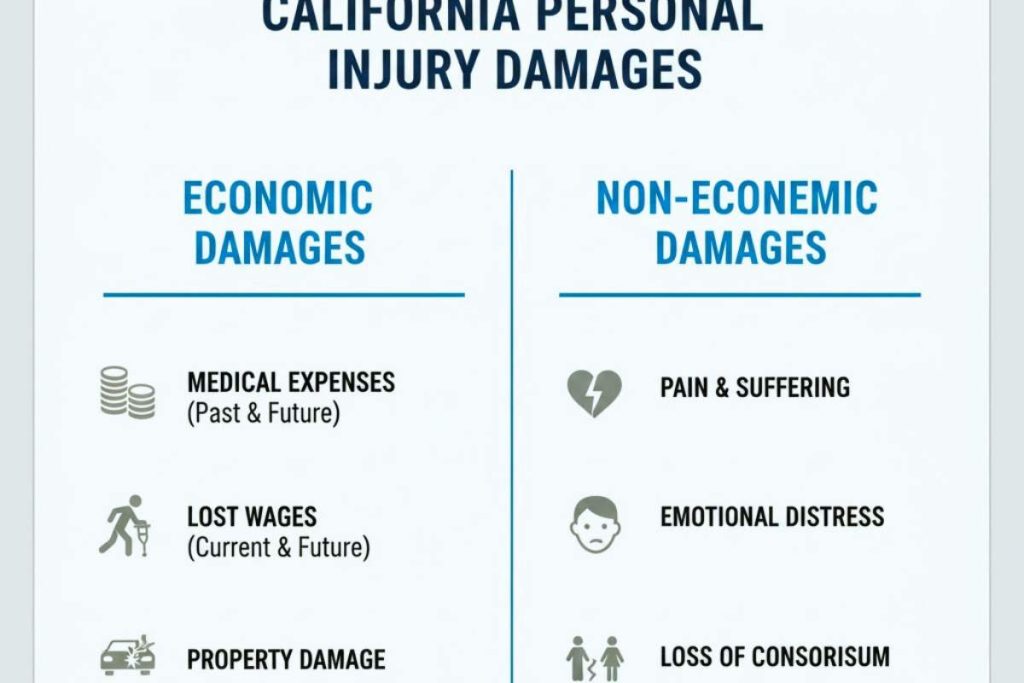
Compensation in a California personal injury case is a legal evaluation of loss categories recognized under state law, not a promise of recovery or a reflection of injury severity alone. Courts and insurers assess compensation by examining defined types of harm, the evidence supporting them, and how those losses are treated within California’s legal framework. Understanding these categories helps clarify what the law measures and where limits and discretion apply.
What are economic damages under California personal injury law?
California law permits recovery of economic damages for verifiable financial losses caused by an injury.
Economic damages are assessed using objective documentation and are reviewed by insurers and courts based on records rather than estimates or personal descriptions.
Medical expenses include costs for care that is medically necessary and supported by treatment records. These may involve emergency services, hospital care, rehabilitation, medication, or follow-up treatment.
Lost income refers to earnings missed because an injury prevented work. This category is evaluated using employment records, tax documentation, or employer confirmation rather than projected or assumed loss.
Reduced earning capacity addresses whether an injury limits future ability to earn income. This evaluation looks beyond short-term wage loss and considers long-term impact, supported by medical findings and, where appropriate, vocational analysis.
What are non-economic damages in California injury cases?
California law recognizes non-economic damages for non-financial harm resulting from an injury.
These damages account for personal impact that does not have a direct monetary record but is still legally recognized.
Pain and suffering reflects the physical discomfort associated with injury and treatment. It is assessed based on medical evidence, duration, and severity rather than a fixed calculation.
Emotional distress involves psychological effects connected to physical injury, such as anxiety or disruption. Evaluation focuses on consistency, credibility, and supporting medical or psychological documentation.
Loss of enjoyment of life addresses limitations on normal activities caused by injury. Courts consider how documented physical restrictions affect daily functioning rather than subjective preference alone.
When do punitive damages apply in California?
Yes, but only in narrowly defined circumstances. Punitive damages are not part of most personal injury claims.
Punitive damages are intended to address conduct that goes beyond ordinary negligence. They focus on deterrence and punishment rather than compensation.
They do not apply when injury results from carelessness alone, and they are not triggered by injury severity. Their availability depends on the nature of the conduct and must be supported by specific evidence meeting higher legal thresholds.
Because of these requirements, punitive damages are uncommon and subject to additional judicial scrutiny and limitation.
How does wrongful death compensation differ from personal injury compensation?
Wrongful death claims are governed by a separate legal framework under California law.
Although they arise from fatal injuries, they are distinct from personal injury claims and are brought by qualifying family members or representatives.
The damage categories differ as well. Wrongful death compensation focuses on losses experienced by surviving family members rather than the decedent’s medical treatment or personal suffering. For this reason, wrongful death compensation is evaluated independently and under different legal standards.
Deadlines and Time Limits for California Injury Claims
Time limits play a central role in California personal injury law. These deadlines do not reflect the seriousness of an injury or the strength of a claim. They exist to define when a court is legally allowed to hear a case. Understanding how these limits operate helps explain why timing can matter even when liability or damages seem clear.
What is the general statute of limitations for personal injury in California?
California law sets a general time limit for filing personal injury claims.
The statute of limitations establishes how long an injured person has to bring a civil claim after an injury occurs. This deadline exists to promote fairness in the legal process by ensuring that claims are brought while evidence is still reasonably available.
Deadlines also protect against indefinite exposure to liability. Over time, memories fade, records are lost, and physical conditions change. The statute of limitations balances the ability to pursue a claim with the need for reliable evidence.
When a deadline passes, the consequence is procedural rather than evaluative. Courts generally lack authority to hear a claim filed after the statute of limitations expires, regardless of injury severity or apparent fault.
Are there shorter deadlines for government and special claims?
Yes. Claims involving public entities are subject to shorter and separate deadlines.
When an injury involves a government agency or public entity, California law requires additional steps before a lawsuit may be filed.
These claims are governed by specific notice requirements. An injured person must typically submit a formal claim to the public entity within a defined period. This notice allows the entity to review the claim before litigation begins.
If required notice is not provided within the applicable timeframe, a later lawsuit may be barred. These rules apply even when the underlying injury would otherwise fall within the general statute of limitations.
Can statutes of limitations be paused or extended in California?
Yes. California law recognizes limited situations where deadlines may be paused or adjusted.
These exceptions are defined by statute and interpreted narrowly.
For minors, the statute of limitations is generally paused until the individual reaches legal adulthood. This reflects the legal principle that minors lack full capacity to bring claims on their own.
Delayed discovery may apply when an injury or its cause was not reasonably discoverable at the time it occurred. In these situations, the limitations period may begin when the injury is discovered or should have been discovered through reasonable diligence.
Legal incapacity can also affect deadlines. When an individual is legally unable to manage their affairs, California law may pause the limitations period during that period of incapacity.
These situations do not eliminate deadlines. They adjust when the clock begins or temporarily pauses it, depending on the circumstances and applicable law.
Medical Bills, Liens, and Settlement Reductions

Settlement figures are often discussed as totals, but California law does not treat settlement amounts as money that automatically belongs to the injured person. Medical bills, reimbursement rights, and lien claims can reduce what is ultimately received. Understanding how these reductions work helps clarify why settlement values and take-home amounts are not the same thing.
Why are settlement amounts not the same as take-home amounts?
Settlement amounts represent gross recovery, not net recovery.
A settlement figure reflects the total value assigned to a claim before required payments are addressed. It does not account for obligations that must be satisfied from that amount.
Required reimbursements are a key reason for this difference. When medical care has been paid by insurers, government programs, or providers who assert repayment rights, California law may require reimbursement from the settlement proceeds. These obligations exist independently of fault or injury severity.
Because of these required payments, the amount an injured person actually receives is determined only after liens and reimbursement claims are resolved under applicable law.
What types of liens commonly affect California injury cases?
Several types of liens and reimbursement rights can apply in California personal injury claims.
These claims arise from who paid for medical care and under what legal authority.
Health insurance reimbursement rights may apply when a private insurer or health plan paid medical expenses related to the injury. These rights are often governed by policy terms and applicable state or federal law.
Hospital and provider liens may arise when medical providers treat an injured person with the expectation of payment from a future recovery. These liens are subject to statutory requirements and limitations under California law.
Subrogation rights allow certain payors to step into the position of the injured person to seek repayment for expenses they covered. Subrogation is not automatic in every case and depends on the source of payment and governing law.
Each lien type operates under different rules, which affects how and when repayment may be required.
How does lien resolution work in practice?
Lien resolution involves a separate legal process that occurs alongside settlement or judgment.
Resolution typically requires identifying valid liens, confirming the amounts claimed, and determining whether reductions apply under the law.
Negotiation principles may apply, but they are constrained by legal authority rather than preference. Some liens are fixed by statute or contract, while others may allow adjustment based on factors such as proportional recovery or allocation of fault.
Reduction factors can include limits imposed by law, questions about whether charges were reasonable, or whether the lien holder’s rights extend to the full amount claimed. These factors depend on the lien type and governing rules.
Timing also matters. Liens are often addressed after a settlement is reached but before funds are distributed. Failure to resolve valid liens can delay payment or create additional legal exposure.
Insurance Coverage That Affects Recovery in California
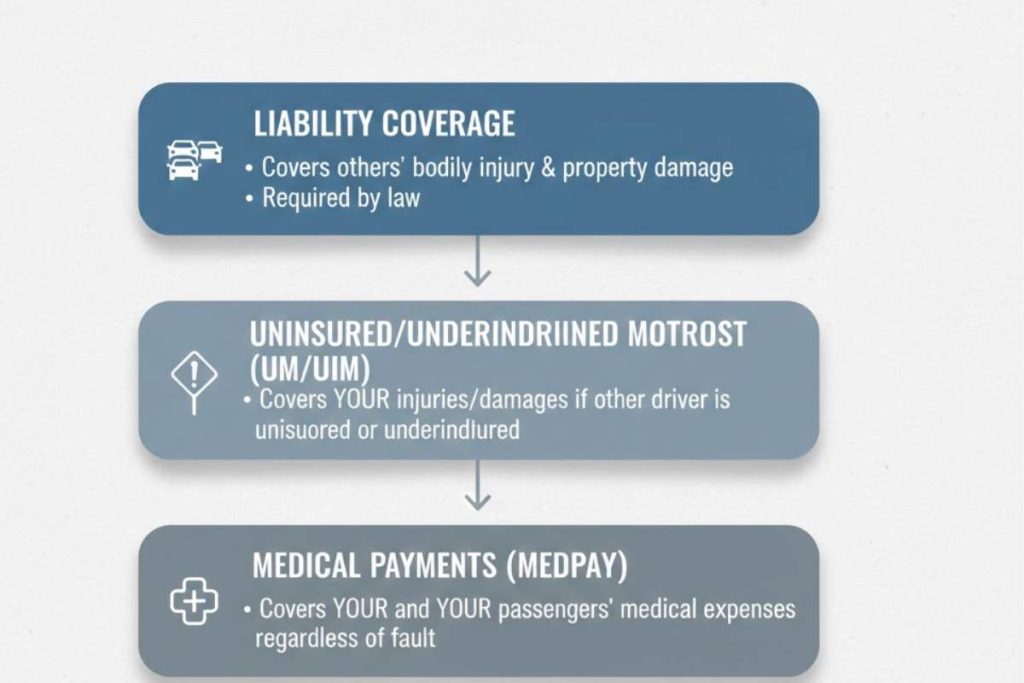
Insurance coverage shapes how injury claims are evaluated long before compensation is discussed. California personal injury law operates within the boundaries of available coverage, policy terms, and statutory requirements. Understanding the types of insurance that may apply helps explain why recovery can differ even when injuries and fault appear similar.
What is liability insurance and how does it function?
Liability insurance is the primary coverage used to address injury claims involving fault.
Liability insurance is designed to cover losses caused by an insured person or entity when they are legally responsible for an injury. It applies only when liability is established and only up to the limits stated in the policy.
This coverage typically addresses damages owed to others, not the insured’s own losses. The insurer’s obligation is defined by the policy contract and applicable California law, not by the severity of the injury alone.
When liability coverage applies, the insurer evaluates claims based on fault, damages, and policy limits. Coverage does not expand simply because losses exceed available limits.
How does uninsured and underinsured motorist coverage apply?
Uninsured and underinsured motorist coverage can apply when the at-fault driver lacks sufficient insurance.
Uninsured motorist coverage addresses situations where the responsible driver has no applicable liability insurance. Underinsured motorist coverage applies when the at-fault driver’s insurance is insufficient to cover the losses claimed.
These coverages are governed by the injured person’s own policy rather than the other driver’s policy. Their availability and scope depend on policy terms and statutory requirements under California law.
UM and UIM coverage do not replace liability analysis. Fault and damages must still be evaluated, but the source of payment shifts based on coverage availability.
What is medical payments coverage?
Medical payments coverage provides limited payment for medical expenses regardless of fault.
Medical payments coverage, often called MedPay, is designed to pay for certain medical expenses arising from an accident without requiring a determination of liability.
This coverage is typically subject to relatively low limits and applies only to defined medical costs. It does not address non-economic damages or broader financial loss.
MedPay operates independently of liability coverage and may apply early in the process, depending on policy terms.
How do policy limits affect underinsured scenarios?
Policy limits define the maximum amount an insurer is obligated to pay.
When damages exceed available policy limits, the claim becomes underinsured in practical terms. California law does not require insurers to pay beyond contracted limits, even when losses are substantial.
Underinsured scenarios highlight the distinction between legal responsibility and available coverage. A finding of fault does not create additional insurance coverage where none exists.
In these situations, recovery is constrained by the interaction of liability coverage, UM or UIM coverage if applicable, and the specific terms of the policies involved.
Evidence That Strengthens a California Personal Injury Claim
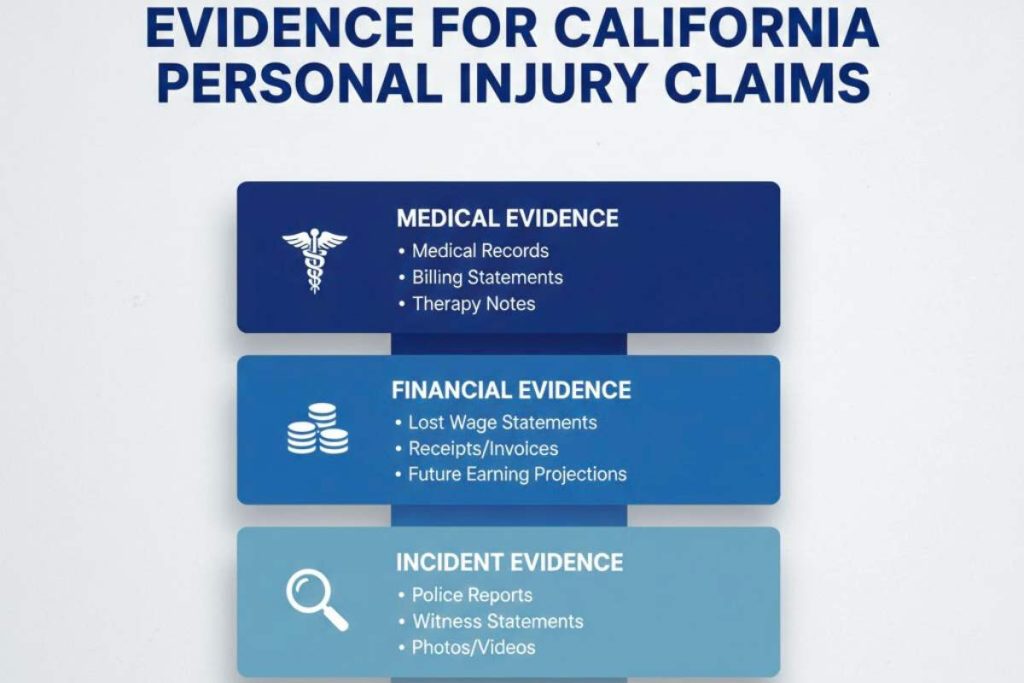
California personal injury law evaluates claims based on evidence, not belief or explanation alone. Evidence does not guarantee an outcome, but it determines what a court or insurer is legally permitted to consider. Understanding the types of evidence that carry weight helps clarify why some claims are well-supported and others are not, even when injuries appear similar.
What medical evidence matters in California injury cases?
Medical evidence is the foundation of most personal injury evaluations.
Medical records document the existence, nature, and progression of an injury. Courts and insurers rely on these records to establish when an injury occurred, how it was treated, and whether it is connected to the incident in question.
This evidence typically includes diagnostic findings, treatment notes, imaging results, and provider observations recorded during care. Consistency across records matters because gaps or contradictions can raise questions about causation or severity.
Medical evidence is evaluated for accuracy and timing, not just volume. Records created close in time to the injury often carry more weight than later summaries.
What financial documentation supports a claim?
Financial records are required to support claims for economic loss.
Economic damages must be shown through documentation rather than assertion. Courts and insurers look to objective records to determine whether losses are attributable to the injury.
This documentation may include medical bills, payment statements, wage records, tax filings, or employer verification. The purpose is not to calculate totals in isolation, but to link financial impact to the injury itself.
Incomplete or unsupported financial claims may be discounted, even when injury is otherwise established.
What incident and scene evidence is relevant?
Evidence from the incident itself helps establish how an injury occurred.
Incident and scene evidence provides context for liability analysis. It helps connect conduct to harm by showing conditions, timing, and surrounding circumstances.
This type of evidence may include photographs, videos, incident reports, physical measurements, or contemporaneous notes. Witness information can also be part of this category when it clarifies disputed facts.
Because conditions change, this evidence is often time-sensitive. Its value lies in preserving facts that may not be recoverable later.
When is expert evidence required?
Expert evidence may be necessary when issues exceed common knowledge.
In some cases, courts require expert testimony to explain technical or specialized matters. This can include medical causation, accident mechanics, future care needs, or vocational impact.
Experts do not decide the case. Their role is to assist the court or jury by explaining complex issues using accepted professional standards.
Expert evidence is evaluated for relevance, methodology, and foundation. Unsupported opinion or speculation does not meet legal standards and may be excluded.
Factors That Influence Compensation Value in California Injury Claims
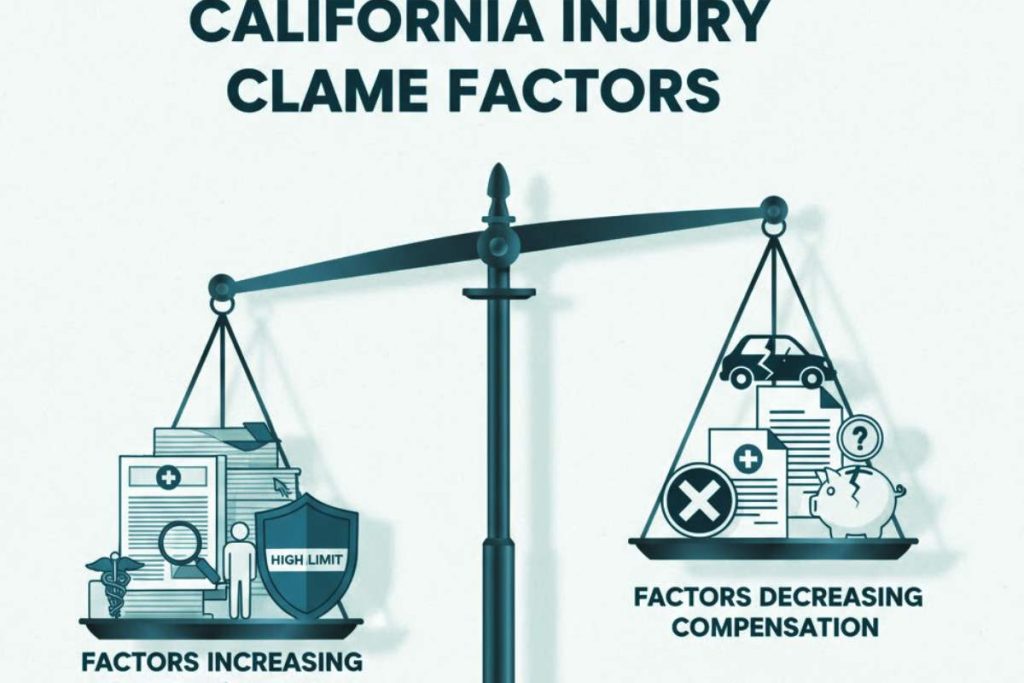
In California personal injury law, compensation value is not assigned or negotiated in the abstract. It develops from how specific factors are evaluated under legal standards, evidence, and available insurance coverage. These factors shape how loss is measured and how disputes are resolved, but they do not create entitlement or predict outcomes.
What factors tend to support a higher valuation under California law?
Certain conditions can support a higher valuation when they are clearly established through evidence and legal analysis.
Clear liability is one such factor. When evidence shows a direct connection between conduct and injury, fewer factual disputes remain over responsibility.
Consistent medical documentation also affects evaluation. Records that show injury onset, treatment progression, and lasting impact allow courts and insurers to assess harm within an established evidentiary framework.
Documented economic loss may further influence valuation. Medical expenses, verified income loss, and substantiated reduction in earning capacity can be considered when they are directly attributable to the injury and supported by records.
These conditions do not determine outcomes. They affect how loss is evaluated within California’s legal system.
What factors tend to limit or constrain valuation?
Certain conditions can limit how compensation is evaluated under California law.
Disputed fault is a common factor. When responsibility is shared or unclear, comparative negligence principles may reduce recoverable damages.
Gaps or inconsistencies in medical treatment can also affect evaluation, not as a judgment of conduct, but because they may complicate causation analysis. When treatment history does not clearly align with injury progression, questions can arise about whether symptoms are attributable to the incident or to other causes.
Insurance coverage limitations also constrain valuation. Policy limits and coverage terms define the maximum amount available, regardless of injury severity or fault findings.
These factors do not negate a claim. They affect how losses are legally measured and what compensation may be available.
How do long-term effects and future care needs influence valuation?
Long-term injury effects and future care needs may influence valuation when supported by medical evidence.
When injuries result in lasting impairment, ongoing treatment, or future medical needs, California law allows those impacts to be considered as part of loss evaluation.
Future care must be grounded in medical opinion and reasonable certainty. Courts and insurers distinguish between treatment that is medically anticipated and care that is merely possible.
Long-term effects may also affect earning capacity or daily functioning. These impacts are evaluated based on documented limitations and professional assessment rather than speculation about future hardship.
Actions That Can Affect How Compensation Is Evaluated in California
In California personal injury law, compensation is evaluated based on evidence consistency, timing, and legal credibility. Certain actions do not invalidate a claim and are not errors in themselves, but they can influence how losses are assessed under established legal standards. Understanding these effects helps explain why claims may be valued differently over time, even when injuries are legitimate.
Can delayed medical treatment affect compensation evaluation?
Yes. Delayed treatment can affect how an injury is evaluated under California law.
When there is a gap between an incident and initial medical care, questions may arise about causation. Courts and insurers examine whether symptoms are reasonably connected to the incident or whether other factors could explain the condition.
Delay does not mean an injury did not occur. However, the absence of contemporaneous medical records can make it more difficult to establish when the injury began and how it progressed.
Do broad medical authorizations affect claim evaluation?
Yes. Broad medical authorizations can affect how medical history is reviewed.
When authorizations allow access to extensive or unrelated medical records, information outside the scope of the injury may become part of the evaluation.
This can introduce issues unrelated to the incident, including prior conditions or treatment history that complicate causation analysis. California law permits relevant inquiry, but expanded disclosures may broaden the scope of review beyond the injury itself.
Can inconsistent injury reporting affect compensation assessment?
Yes. Inconsistent reporting can influence how evidence is weighed.
When descriptions of injury vary across medical records, incident reports, or statements, evaluators may question whether reported symptoms stem from the same event.
These inconsistencies are assessed in context. Minor variation does not defeat a claim, but material differences in symptom description, timing, or severity can affect how credibility and causation are evaluated.
Does social media activity become relevant in injury cases?
Yes. Social media activity may be considered as evidence in some cases.
Public posts, images, or videos can be reviewed if they relate to physical activity, injury claims, or daily functioning.
Social media content does not determine outcomes on its own. When it appears inconsistent with reported limitations, it may be considered alongside medical and other evidence during evaluation.
How can early resolution affect evaluation of future impacts?
Resolving a claim before future impacts are known can limit how those impacts are evaluated.
When a claim is concluded before the full extent of an injury is established, later-developing medical needs or lasting effects may not be reflected in the evaluation.
California law generally treats settlements as final. This is a legal consequence of resolution timing rather than an indication that early resolution is improper. It explains why future effects must be supported by evidence available at the time a claim is evaluated.
When Legal Representation May Become Relevant in California Injury Cases

California personal injury law does not require legal representation in every situation. Many claims are resolved without formal legal involvement. However, certain circumstances introduce legal complexity, evidentiary risk, or procedural exposure that can make self-navigation impractical. This section explains when representation often becomes relevant based on how the system functions, not on preference or pressure.
In cases involving disputed liability, permanent injury, or multiple responsible parties, some people choose to review how legal representation in San Diego personal injury cases functions within California’s civil framework before deciding how to proceed.
Do serious or permanent injuries change the need for representation?
Yes. Serious or permanent injuries can increase legal complexity.
When an injury results in long-term impairment, permanent limitation, or future medical needs, the evaluation of damages becomes more complex. These cases often involve medical causation analysis, future care assessment, and long-term economic impact, all of which require structured legal and evidentiary review.
The issue is not injury severity alone. It is the need to accurately evaluate future consequences under California law using admissible evidence and accepted standards.
Does disputed liability or shared fault affect whether representation is needed?
Yes. Disputed liability or shared fault can make legal evaluation more complex.
When responsibility for an injury is contested, or when multiple parties may share fault, comparative negligence principles apply. These disputes require careful analysis of evidence, witness accounts, and legal standards governing fault allocation.
In these situations, the process often involves formal evidentiary challenges rather than straightforward claim handling, increasing procedural complexity.
Do multiple liable parties or limited insurance change the analysis?
Yes. Claims involving multiple parties or limited insurance coverage raise additional legal issues.
When more than one party may be legally responsible, determining how liability is divided becomes a legal question. Coordination among insurers and evaluation of overlapping responsibilities may be required.
Limited insurance coverage can further complicate evaluation. When potential losses exceed available coverage, legal analysis may be needed to determine how recovery is structured under applicable policies and law.
Does claim denial or litigation risk make representation more relevant?
Yes. Claim denial or the likelihood of litigation increases procedural risk.
When an insurer denies a claim or disputes core elements such as liability or causation, resolution may require formal legal process. Litigation introduces court rules, discovery obligations, and motion practice that differ significantly from pre-litigation claim handling.
At that stage, representation is less about advocacy and more about navigating procedural requirements, evidentiary standards, and court-imposed deadlines within California’s legal framework.
Common Questions About California Personal Injury Law
How long does a personal injury case take in California?
It depends on the facts, complexity, and procedural path of the case.
Some claims resolve within months, while others take significantly longer. Factors that affect timing include injury severity, medical recovery timelines, disputed liability, insurance coverage, and whether litigation becomes necessary.
Cases involving ongoing treatment or contested fault generally take longer because evaluation depends on additional evidence and procedural steps. California law does not set a fixed timeline for resolution.
Can I recover compensation if I was partly at fault?
Yes. California follows a pure comparative negligence system.
This means compensation may still be available even if an injured person shares responsibility for the incident. Any recovery is reduced based on the percentage of fault attributed to each party.
Fault allocation is evidence-based and determined through legal analysis rather than assumption. Shared fault affects valuation, not eligibility to bring a claim.
What is the statute of limitations for injury claims in California?
California law sets time limits for filing injury claims, known as statutes of limitations.
These deadlines define when a court is legally permitted to hear a case. They exist to ensure claims are brought while evidence remains reasonably available.
Different rules apply to government claims, minors, delayed discovery, and legal incapacity. These situations can change when the limitations period begins, but they do not eliminate deadlines entirely.
How does the insurance negotiation process work?
Insurance negotiation is an evidence-based evaluation process.
Claims are reviewed based on liability analysis, medical documentation, financial loss records, and applicable policy terms. Insurers assess information in stages and may request clarification or additional documentation as the claim develops.
Disagreement during negotiation is common and does not indicate final resolution. Negotiations reflect differing interpretations of responsibility, damages, and coverage rather than a guaranteed outcome.
What damages can I recover under California law?
California law recognizes multiple categories of damages, subject to proof.
These include economic damages for documented financial loss and non-economic damages for non-financial harm such as pain or loss of enjoyment of life. Punitive damages are available only in limited circumstances involving specific types of conduct.
Availability and scope depend on evidence, legal standards, and the nature of the claim.
Will medical bills be paid from my settlement?
Medical bills and reimbursement claims can reduce settlement proceeds.
Settlement amounts are evaluated on a gross basis. Liens, reimbursement rights, and subrogation claims may require payment from settlement funds before distribution.
Whether and how medical bills are paid depends on who provided coverage, the type of lien involved, and applicable California law.
What if the at-fault party has no insurance?
Lack of insurance can limit available recovery but does not change fault analysis.
If the responsible party has no applicable liability coverage, recovery may depend on other available insurance, such as uninsured motorist coverage, or may be constrained by the absence of coverage.
California law distinguishes between legal responsibility and available sources of payment. Fault does not create insurance where none exists.
What California Personal Injury Law Does Not Do
California personal injury law establishes a framework for evaluating civil injury claims, but it has clear limits. Understanding what the law does not do is just as important as understanding what it allows. This section clarifies common misconceptions and prevents expectations that the legal system itself does not support.
Does personal injury law guarantee compensation?
No. California personal injury law does not guarantee compensation.
The law provides a process for evaluating claims, not a promise of recovery. Compensation depends on proof of liability, documented damages, and available sources of payment such as insurance or assets.
Even when an injury is real, recovery may be limited or unavailable if legal standards are not met or coverage does not exist.
Does personal injury law determine criminal guilt?
No. Personal injury law addresses civil responsibility, not criminal liability.
Civil injury claims evaluate whether one party is legally responsible for another’s harm under negligence or related standards. Criminal guilt is determined through a separate legal system with different burdens of proof and consequences.
A civil claim can exist without a criminal case, and a criminal case does not automatically establish civil liability.
Does personal injury law replace insurance policy limits?
No. Personal injury law does not override insurance coverage limits.
Insurance policies define the maximum amount available for payment, regardless of injury severity or fault findings. Courts cannot require insurers to pay beyond policy limits unless separate legal obligations apply.
Legal responsibility and available compensation are related but distinct concepts under California law.
Does personal injury law move quickly by default?
No. California personal injury law does not impose fixed timelines for resolution.
The pace of a claim depends on medical recovery, evidence development, procedural steps, and whether disputes arise. Some claims resolve efficiently, while others require extended evaluation or litigation.
Delays often reflect complexity rather than error or misconduct.
Does personal injury law eliminate uncertainty?
No. Personal injury law operates within evidentiary and factual uncertainty.
Injury claims involve medical opinions, factual disputes, and differing interpretations of responsibility. The legal process is designed to manage uncertainty through standards and procedure, not to remove it entirely.
Outcomes depend on how evidence is evaluated within those constraints.
How to Use This Information Moving Forward
California personal injury law provides a statewide framework for evaluating civil injury claims. It defines legal responsibility, outlines the claims process, and explains how compensation is assessed when legal standards are met. It also sets clear limits on what the law does and does not provide.
This guide is meant to help readers orient themselves within that framework. It explains how rights arise, how claims are evaluated, and where outcomes depend on evidence, procedure, and timing, not assumptions. That understanding makes it easier to interpret next steps, questions, and related information with clarity.
From here, readers may choose to explore specific injury categories, procedural topics, or insurance and compensation issues, all of which operate within the same legal structure described above.
The purpose of this page is to explain how California personal injury law works, not to direct decisions or outcomes.
Authoritative Legal References and Sources
The information in this guide is grounded in publicly available California statutes, court rules, and regulatory resources. These sources define how personal injury law is applied statewide and provide the legal standards referenced throughout this page.
California Civil Code
The California Civil Code establishes core principles of civil liability, including negligence, fault, and damages.
https://leginfo.legislature.ca.gov/faces/codes_displayText.xhtml?lawCode=CIV
California Code of Civil Procedure
The California Code of Civil Procedure governs filing requirements, deadlines, court procedures, and litigation rules that apply to personal injury claims.
https://leginfo.legislature.ca.gov/faces/codes_displayText.xhtml?lawCode=CCP
California Courts
The California Courts website provides official guidance on court structure, civil case procedures, and jury instructions used to evaluate personal injury claims.
Relevant jury instruction framework (CACI):
https://courts.ca.gov/partners/california-jury-instructions/civil-jury-instructions-resource-center/civil-jury-instructions
California Department of Insurance
The California Department of Insurance regulates insurance practices and provides consumer guidance relevant to liability coverage, claims handling, and policy interpretation.