

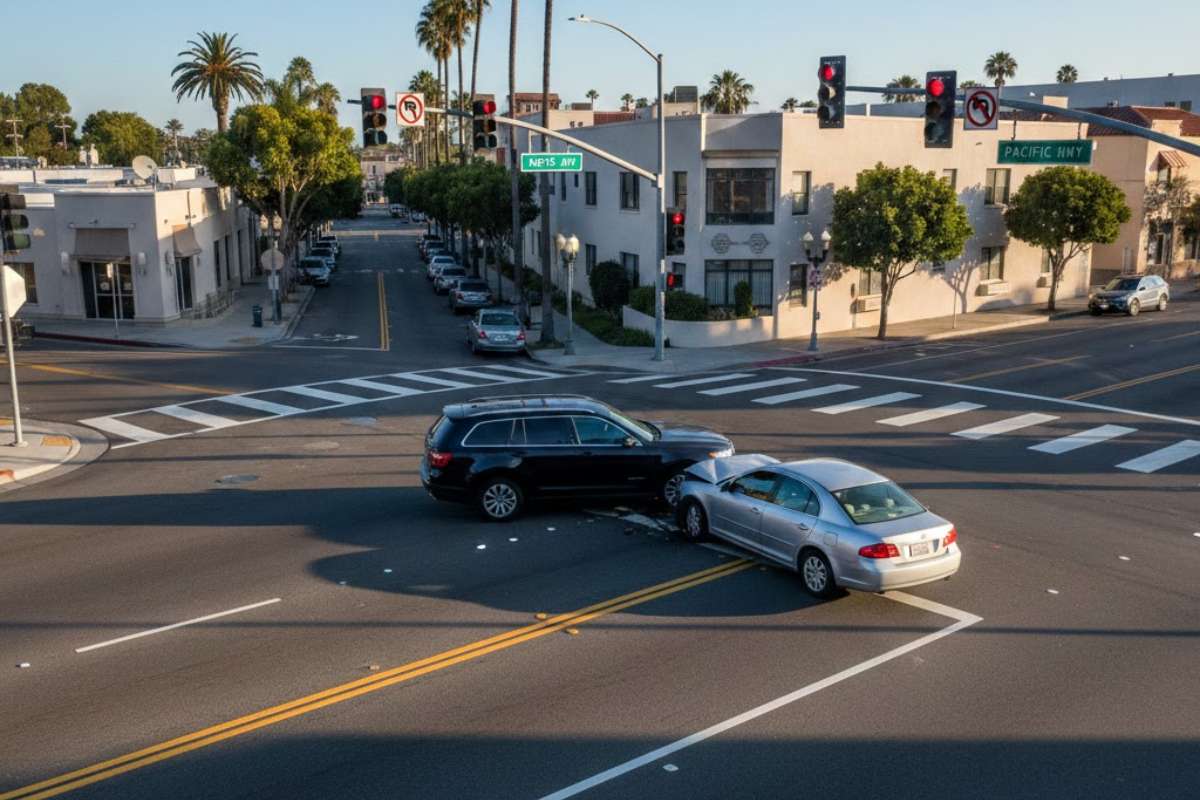
Car accident liability in San Diego refers to how California civil law assigns legal responsibility for a crash based on conduct, causation, and provable harm. It is not a judgment about who feels wronged and it is not decided by the seriousness of injuries alone. Liability is evaluated by applying defined legal standards to documented facts, including what each party did, whether that conduct met the duty of reasonable care, and how directly it contributed to the collision.
That distinction matters early. When liability is misunderstood, people often assume fault is obvious or fixed. Under California law, it is neither. Responsibility can be shared, reallocated, or reduced depending on evidence and timing. In San Diego, where traffic patterns, roadway design, and enforcement practices vary by area, those details often shape how fault is analyzed.
The sections that follow walk through how California determines fault in car accidents, what evidence is weighed, and why liability findings affect outcomes even when injuries are not disputed.
What Liability Means in a San Diego Car Accident
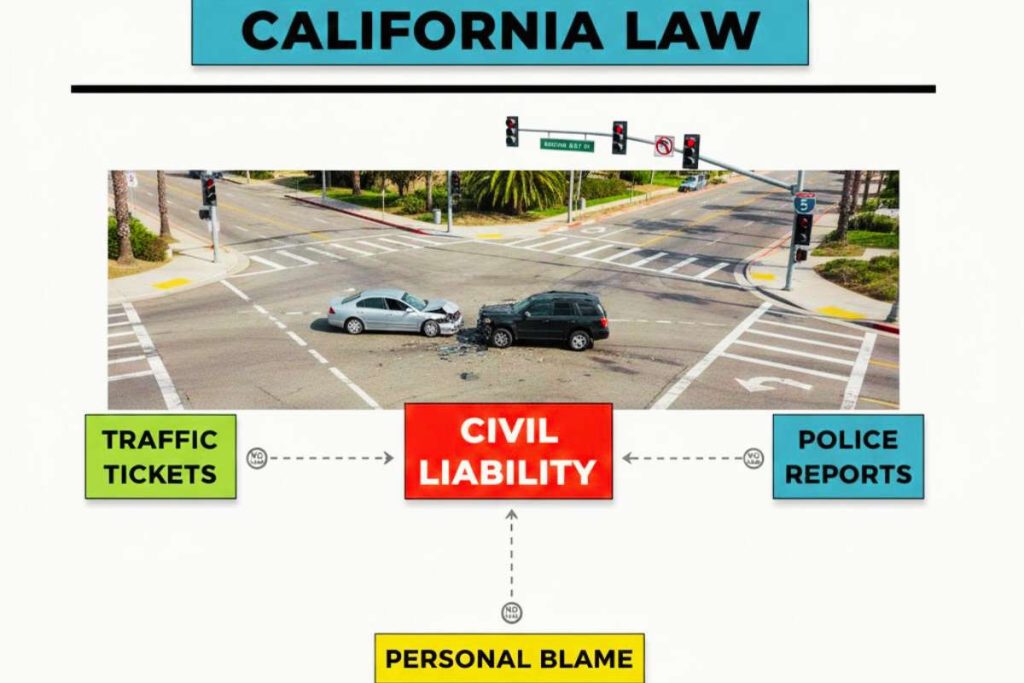
Liability in a San Diego car accident refers to civil responsibility under California law, not personal blame or moral fault. It is the legal framework courts and insurers use to decide whether one party is financially responsible for another person’s injuries and losses.
This distinction matters early because liability is often confused with things that feel decisive but are not. A traffic citation, a police report, or an on-scene admission may influence how an accident is reviewed, but none of those determines civil liability on its own. California injury claims are evaluated through a separate legal process with different standards and consequences.
Under California law, liability is assessed through negligence analysis. That analysis asks whether a duty of care existed, whether that duty was breached, whether the breach caused the injury, and whether legally recognizable damages resulted. These elements are evaluated together, not in isolation, and none of them is presumed simply because an accident occurred.
This framework is grounded in California Civil Code §1714, which establishes that individuals are responsible for injuries caused by their lack of ordinary care, except where the law provides otherwise. The focus is on conduct and causation, not intent or character.
When liability is misunderstood, people often misjudge claim value early, assume fault that does not hold up under legal review, or place too much weight on a citation that carries little civil significance. Those assumptions can shape decisions long before the legal framework is fully applied.
How California Law Determines Fault After a Car Accident
Fault in a California car accident is not decided by instinct or first impressions. It is evaluated through a legal test that looks at how conduct, responsibility, and harm connect under civil law. This framework explains why fault assessments can change over time as evidence develops.
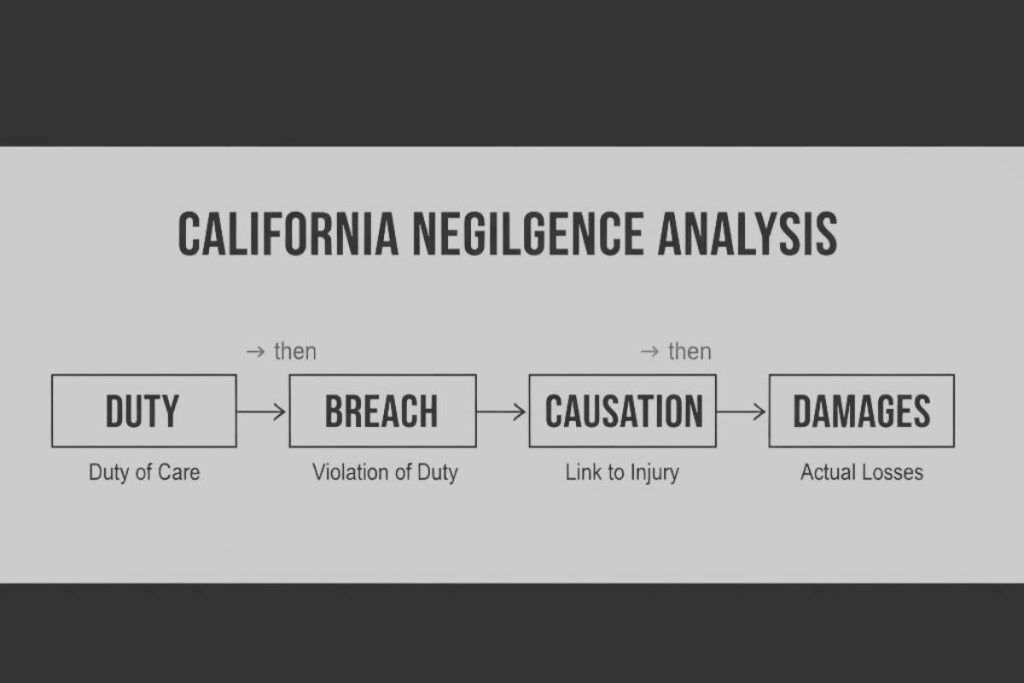
Under California law, fault is evaluated through four connected elements. All four must align for legal responsibility to exist.
- Duty of care
Every driver has a legal obligation to operate a vehicle with reasonable care under the circumstances. This duty exists regardless of intent and applies anytime someone is driving on a public road. - Breach of duty
A breach occurs when a driver’s actions fall below that reasonable care standard. This could involve speed, attention, decision-making, or compliance with traffic laws, depending on the situation. - Causation
Causation asks whether the breach actually caused the collision and resulting injury. If the harm would have occurred regardless of the conduct, legal responsibility may not attach. - Damages
Damages refer to legally recognized harm, such as physical injury, property loss, or financial impact. Without provable damages, fault does not translate into civil liability.
Fault depends on whether all four elements connect to form legal responsibility. If one element breaks, the analysis changes.
Negligence Explained in Plain English
Negligence is the standard California uses to evaluate fault in most car accidents.
Negligence does not mean recklessness or bad intent. It refers to a failure to act with the level of care a reasonably careful driver would use in a similar situation. The law looks at conduct in context, not outcomes in isolation.
This is why two crashes that look similar on the surface can be evaluated differently. The question is not who suffered more damage, but whether a driver’s conduct crossed the legal threshold for responsibility when all elements are considered together.
Why Evidence Matters More Than Statements
Evidence carries more weight than personal accounts when fault is evaluated.
Statements made at the scene reflect perception, not legal analysis. California fault determinations rely on evidence that can be tested against the negligence standard, such as physical damage, roadway conditions, vehicle data, medical records, and third-party observations.
This is also why early assumptions about fault often change. Once evidence is reviewed and placed within the four-part legal framework, responsibility may be reassessed based on how duty, breach, causation, and damages actually connect.
Who Can Be Held Liable in a San Diego Car Accident
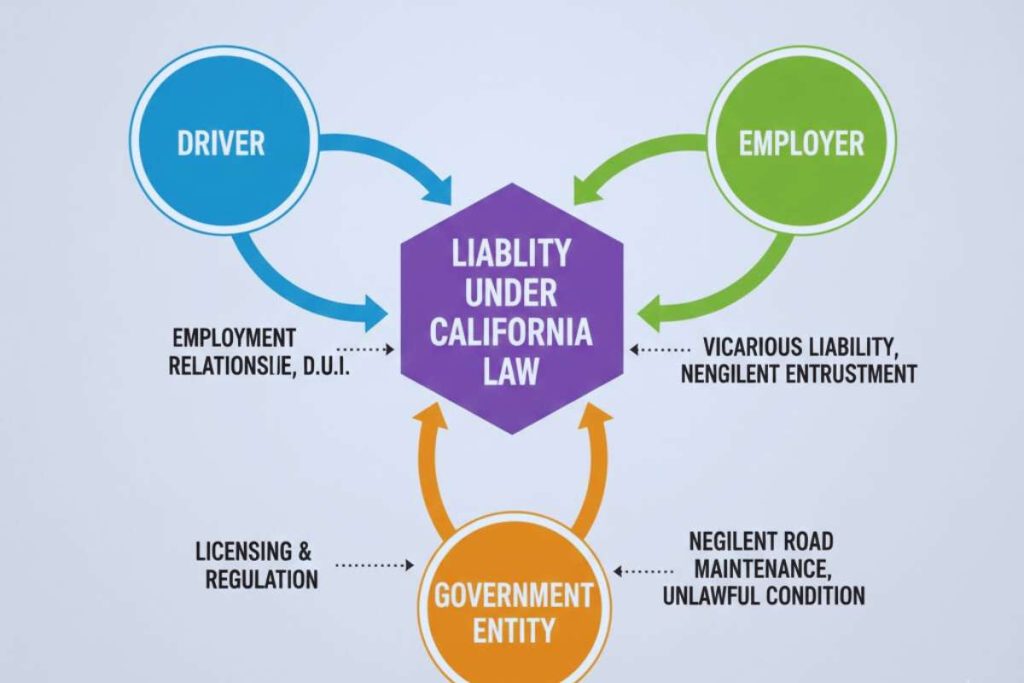
Liability in a San Diego car accident is not limited to the person who was driving. California law assigns civil responsibility based on legal duty, control, and relationship to the conduct, not simply on who was behind the wheel. That distinction matters because many crashes involve vehicles, work duties, or roadway conditions that place responsibility on parties beyond the driver.
This section outlines who California law may treat as legally responsible, and why those determinations extend beyond driver-only thinking.
Driver Liability
Drivers can be held liable when their conduct breaches the duty of reasonable care.
Under California law, drivers owe a duty to operate their vehicles with reasonable care under the circumstances. When a driver fails to meet that standard and that failure causes harm, civil liability may attach. This evaluation is evidence-based. It looks at driving behavior, traffic conditions, and compliance with applicable laws, not intent or personal character.
Driver liability focuses on conduct at the time of the collision and whether that conduct created an unreasonable risk of harm that resulted in injury or damage.
Employer or Commercial Vehicle Liability
Employers may be held liable when a crash occurs within the scope of employment.
California recognizes vicarious liability through the doctrine commonly known as respondent superior. Under this framework, an employer can be legally responsible for a car accident caused by an employee when the driving activity was part of the employee’s job duties, even if the employer was not present and did not directly cause the crash.
The legal hinge is not job title or vehicle ownership. It is whether the employee was acting within the scope of employment at the time of the collision. Deliveries, service calls, and work-related travel often fall within this analysis, while purely personal errands may not.
This distinction becomes especially important in cases involving employer-owned or regulated vehicles, where commercial truck accident liability in San Diego often turns on scope of employment, operational control, and layered insurance responsibilities rather than driver conduct alone.
Source: California Civil Code §2338 (respondent superior and principal liability)
Government or Roadway Liability
Government entities can be held liable when roadway conditions contribute to a crash.
When a car accident is caused or worsened by unsafe roadway design, poor maintenance, or missing warnings, California law allows claims against public entities under defined circumstances. These cases focus on whether the government entity had responsibility for the roadway, knew or should have known about a dangerous condition, and failed to address it within a reasonable time.
Government liability follows a different legal process than claims against private parties. While fault is still evaluated through evidence, these claims are subject to separate procedural rules and notice requirements that affect how and when responsibility can be asserted.
Situations Where Fault Is Presumed Under California Law
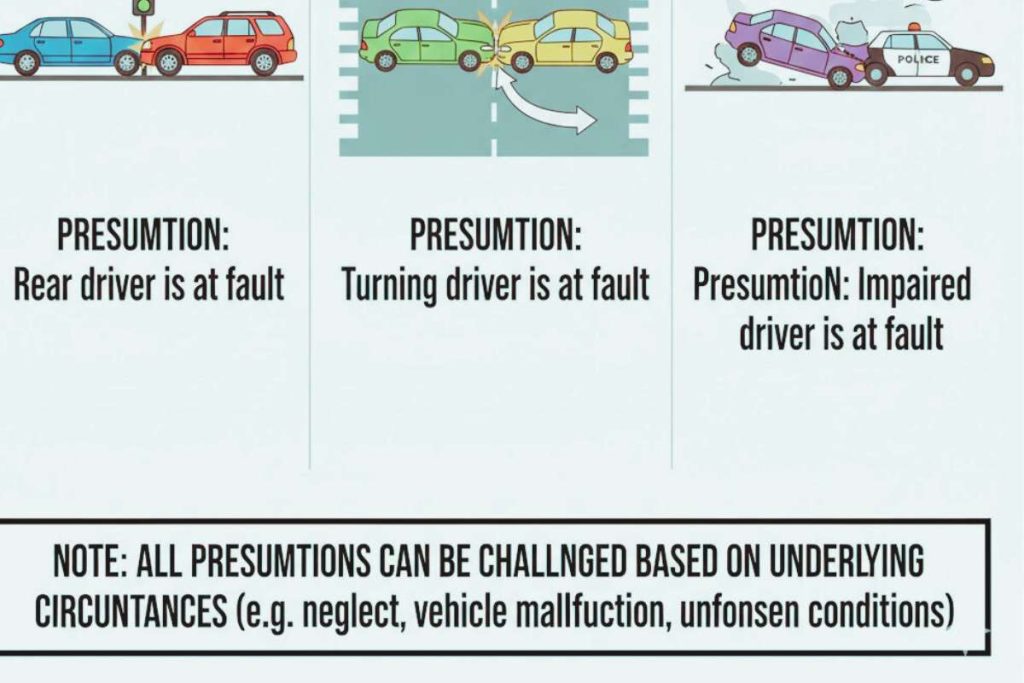
Some collision scenarios create an initial legal presumption about fault under California law. These presumptions exist to organize early analysis, not to decide responsibility outright. They establish a starting point based on common risk patterns, but they remain open to challenge when evidence shows a different sequence of events.
The key distinction matters: a presumption guides investigation, it does not conclude liability.
Rear-End Collisions
Rear-end collisions often create a presumption that the trailing driver failed to maintain a safe following distance.
California law requires drivers to operate their vehicles at a distance that allows them to stop safely under existing traffic and road conditions. When a rear-end impact occurs, that duty creates an inference that the trailing driver breached it.
That inference can change. Evidence showing sudden lane changes, unexpected stops, mechanical failure, or unsafe conduct by the lead driver can alter how fault is ultimately allocated.
Left-Turn Accidents
Left-turn accidents commonly create a presumption against the turning driver.
Drivers making left turns must yield to oncoming traffic that is close enough to pose a hazard. When a collision occurs during a left turn, the law often treats the turning movement as the initial point of analysis.
This presumption is not absolute. Speeding by the oncoming vehicle, signal violations, obstructed sightlines, or roadway design issues may affect how responsibility is evaluated.
DUI-Related Crashes
Driving under the influence can create a strong presumption of negligence.
California law treats DUI violations as evidence of negligence because intoxication directly impairs the ability to exercise reasonable care. When impairment is established, it often shapes early fault assessment.
Even so, intoxication alone does not automatically assign full responsibility. Causation still matters. The conduct must be shown to have contributed to the crash, and other factors may still be considered in fault allocation.
Why Presumptions Do Not End the Analysis
Presumptions help courts and insurers identify likely duty breaches early. They do not replace evidence. Liability is ultimately determined by examining conduct, causation, and damages together under California’s comparative fault system.
That is why fault determinations often evolve as facts develop rather than remaining fixed from the initial assessment.
How Comparative Negligence Affects Car Accident Liability in California
Fault in a California car accident is not treated as all or nothing. The law assumes that responsibility can be shared, measured, and divided based on evidence. This is where comparative negligence comes into play, and it directly affects how liability is evaluated and how compensation is calculated.
California uses a pure comparative negligence system.
That means fault is assigned by percentage, and each party remains legally responsible only for their share of the harm. There is no cutoff point where partial fault eliminates a claim altogether.
This framework comes from California courts applying Civil Code section 1714, which allows liability to be apportioned rather than assigned absolutely. The result is a system that focuses on proportional responsibility rather than binary blame.
To understand how this works in practice, it helps to see how fault percentages affect recovery.
| Fault Assigned to You | Fault Assigned to Other Party | Effect on Compensation |
|---|---|---|
| 0% | 100% | No reduction |
| 20% | 80% | Reduced by 20% |
| 50% | 50% | Reduced by 50% |
| 80% | 20% | Reduced by 80% |
The table shows the mechanism clearly. As your share of fault increases, the recoverable portion decreases proportionally. The calculation itself is straightforward. The dispute is usually over how the percentages are assigned.
What Happens When Both Drivers Share Fault
Fault can be shared between drivers.
When evidence shows that more than one driver contributed to a crash, California law requires responsibility to be divided according to each party’s conduct.
This often occurs in situations involving speed, following distance, lane changes, or reaction time. One driver may have created risk, while the other failed to avoid it. The law does not collapse those behaviors into a single conclusion. It separates them and assigns weight to each.
What matters is not who made the first mistake, but how each action contributed to the collision and resulting harm.
Why Partial Fault Does Not Bar Recovery
No, partial fault does not prevent recovery under California law.
Even when an injured driver is found partially responsible, the claim remains legally viable. The only change is mathematical, not procedural.
This distinction matters because fault assessments often evolve as evidence develops. Initial assumptions may shift once vehicle data, medical records, or expert analysis are reviewed. California’s comparative negligence system allows those shifts to be reflected in adjusted percentages rather than absolute denial.
The law is designed to measure contribution, not to punish imperfection.
What Happens When Fault Cannot Be Clearly Determined
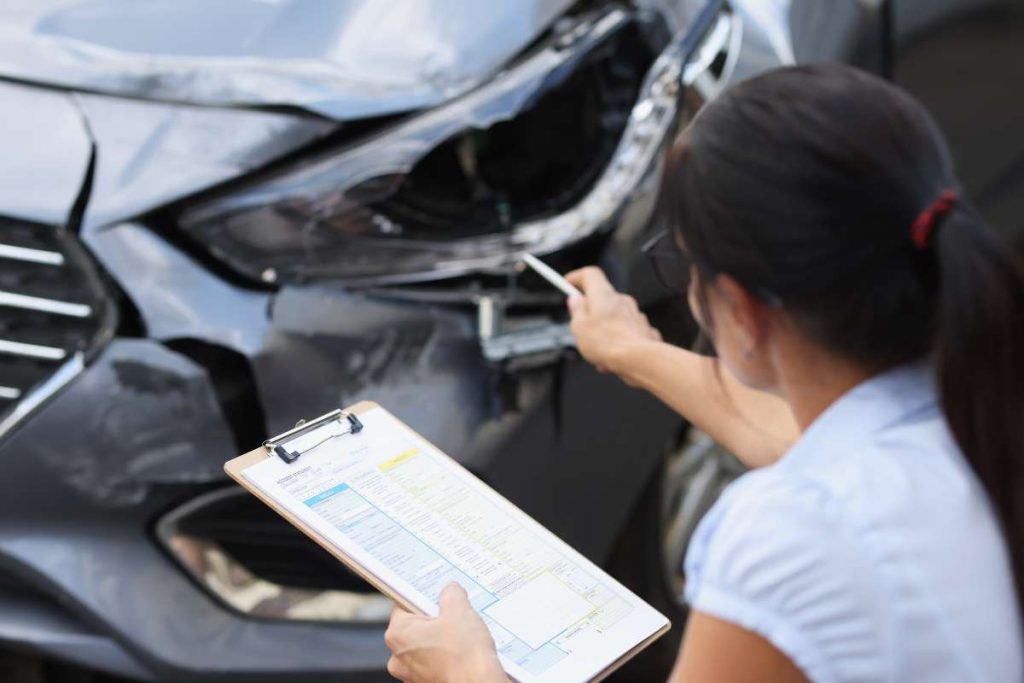
Not every car accident in San Diego produces a clean liability picture. In some cases, the facts do not line up neatly, even after initial investigation. When that happens, California law does not guess or default to fairness. It relies on evidentiary standards to decide how uncertainty is handled.
When fault is unclear, responsibility is evaluated based on burden of proof and evidentiary weight, not on which version of events feels more reasonable.
How Insurers Handle Unclear Liability
When evidence conflicts or gaps exist, insurers compare competing narratives rather than accepting either one at face value. Each side’s account is weighed against available documentation, physical evidence, and consistency over time.
Fault percentages may still be assigned in these situations. These percentages do not represent a legal finding. They reflect how insurers assess risk exposure based on incomplete or disputed information. In practical terms, this assessment influences settlement posture rather than establishing legal responsibility.
Why Evidence Gaps Change Claim Value
When evidence does not clearly support one version of events, the claim’s value often shifts. This does not mean the claim lacks merit. It means uncertainty affects how confidently liability can be asserted.
Evidence gaps increase the likelihood of disputed fault allocations, which in turn affects how damages are evaluated. The greater the uncertainty, the more weight is placed on corroborating records, independent witnesses, and physical or digital proof that can narrow the factual dispute.
When Legal Resolution Becomes Necessary
If liability remains unresolved through evidence review alone, the dispute may require formal legal resolution. At that point, uncertainty is addressed through procedural tools such as discovery, evidentiary rules, and judicial oversight.
Courts do not resolve unclear fault by preference or intuition. They apply standards that determine which evidence is admissible, how credibility is assessed, and whether the burden of proof has been met. This process exists to convert uncertainty into legally supportable conclusions when informal resolution cannot.
The Role of Police Reports and Citations in Liability Decisions
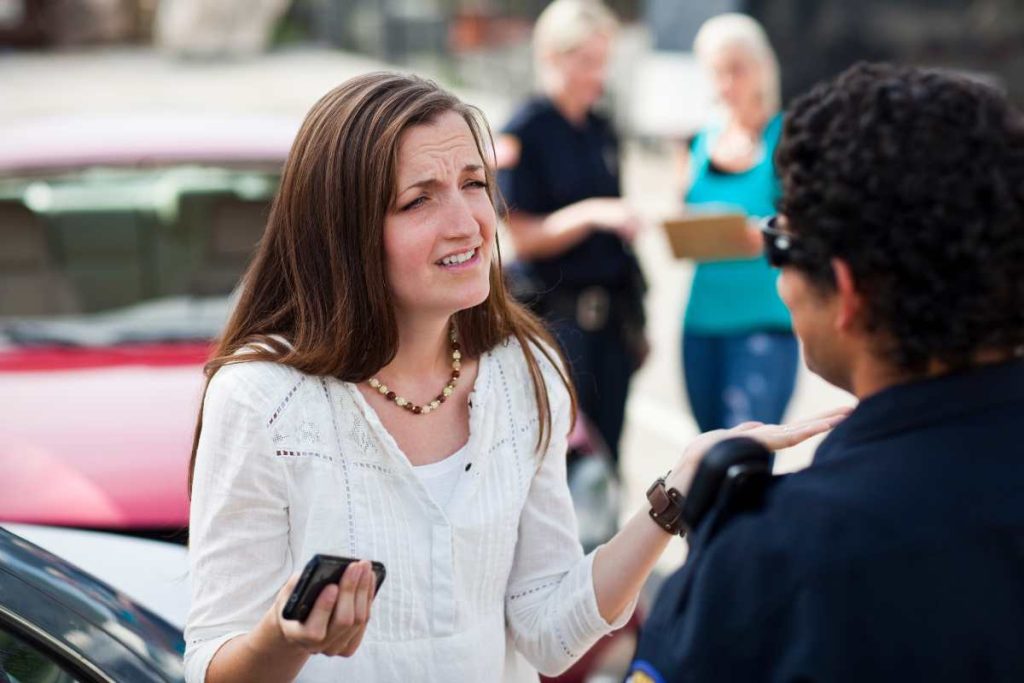
Police involvement after a car accident often feels decisive. A report is written. A citation may be issued. It can look like fault has already been decided. Under California law, that impression is inaccurate, and relying on it can distort how liability is later evaluated.
Police reports serve an administrative and evidentiary function, not a legal one. They document observations made at the scene, statements given at the time, and visible conditions such as vehicle damage or road layout. What they do not do is determine civil liability. Fault in a California car accident is evaluated later using negligence standards, evidence review, and legal analysis, not the officer’s conclusions.
Citations operate in a separate system. A traffic ticket addresses whether a driver may have violated the Vehicle Code. It does not establish civil responsibility for injuries or financial loss. A driver can receive a citation and still be found partially or even minimally liable in a civil claim. The reverse can also occur. The two determinations are independent because they answer different legal questions.
Police reports and citations can still matter. They may influence how insurers begin an investigation or how evidence is framed early on. But they are not binding, and they are not final. Liability decisions depend on how evidence holds up over time, how credibility is assessed, and how the facts align with California negligence law.
Understanding this distinction prevents misplaced confidence or unnecessary concern based solely on what happened at the roadside. It clarifies why liability remains an evidentiary question long after the report is filed.
How Insurance Coverage Affects Who Ultimately Pays
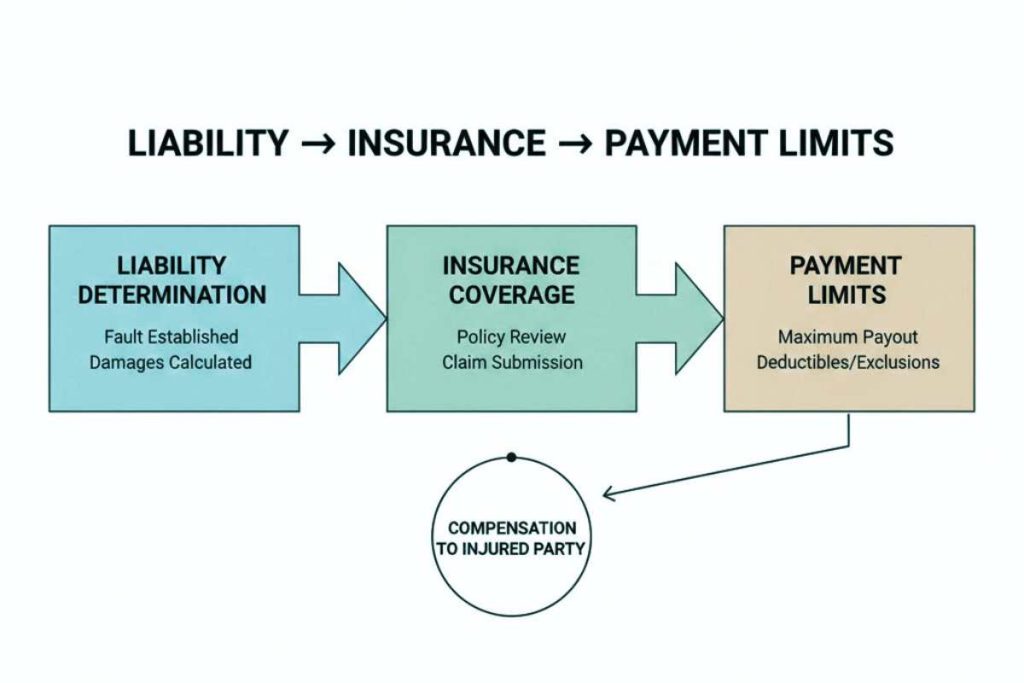
Fault answers who is legally responsible. Insurance answers who actually pays and how much. California law treats these as related but separate questions, and that distinction matters once a claim moves out of theory and into real-world recovery.
Liability insurance is the primary mechanism that converts legal responsibility into payment. When a driver is found at fault, their liability policy responds up to the limits stated in the policy. The insurer’s obligation is contractual. It does not expand based on injury severity, fault clarity, or fairness considerations. Once policy limits are reached, the insurance obligation ends, even if documented losses continue.
Uninsured and underinsured motorist coverage operates differently. UM coverage applies when the at-fault driver has no liability insurance at all. UIM coverage applies when the at-fault driver’s insurance exists but is insufficient to cover the losses being claimed. In both situations, the injured person’s own policy becomes the source of potential payment. Fault still must be established, but recovery is governed by policy terms rather than the other driver’s coverage.
Policy limits ultimately define the ceiling of most recoveries. California law does not require insurers to pay beyond contracted limits, and a clear fault determination does not create additional insurance where none exists. This is why two accidents with identical liability findings can produce very different financial outcomes. The legal analysis may be the same. The available coverage is not.
San Diego-Specific Factors That Complicate Car Accident Liability
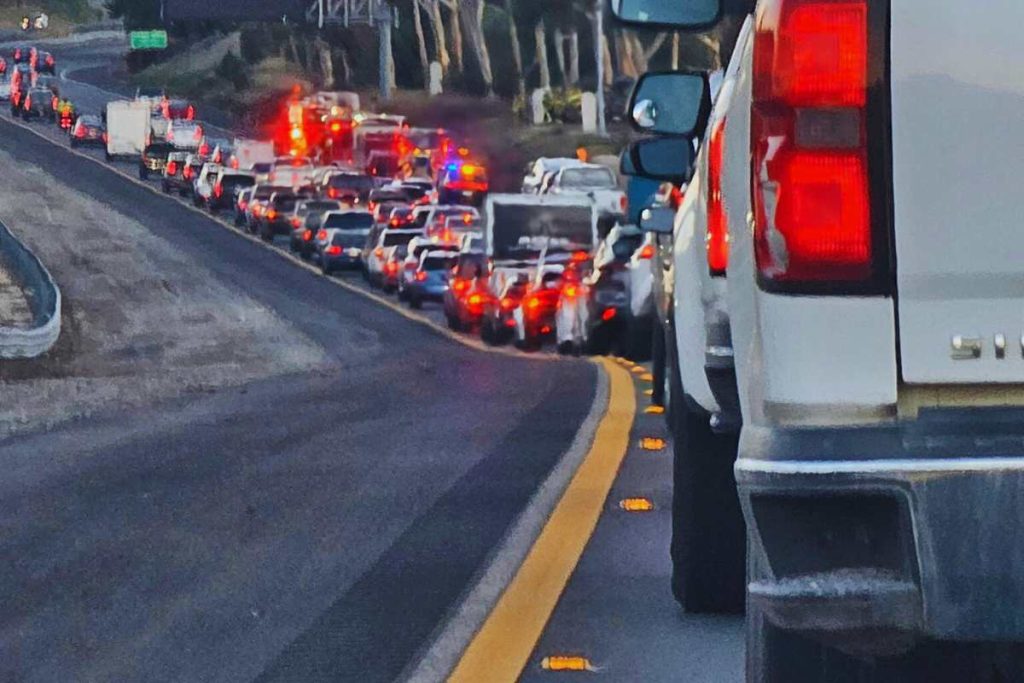
California liability rules apply statewide, but the facts that drive fault analysis do not arise in a vacuum. In San Diego, certain local conditions routinely complicate how responsibility is evaluated after a car accident. The law stays the same. The evidentiary demands change.
Dense traffic corridors create frequent lane changes, short following distances, and overlapping right-of-way claims. When multiple drivers are reacting at once, liability often turns on timing and vehicle positioning rather than obvious misconduct.
Multi-vehicle freeway crashes are common on routes like I-5, I-805, and I-15. These incidents raise chain-reaction questions about who initiated the sequence versus who failed to respond appropriately once hazards developed. Fault analysis often depends on reconstructing the order of events, sometimes second by second.
Tourism and rental vehicles add another layer of complexity. Out-of-area drivers may be unfamiliar with road layouts, exits, or traffic patterns, which can affect foreseeability and response expectations under the reasonable care standard.
In practice, these conditions frequently shift liability analysis away from broad assumptions and toward close examination of event sequencing, reaction windows, and how individual driving decisions interacted in real time.
When Legal Representation Becomes Relevant in Liability Disputes
California law does not require legal representation to determine liability in every car accident. Many situations resolve through insurance review and evidence exchange without formal legal involvement. Representation tends to become relevant only when the liability analysis itself grows complex or contested, and the outcome depends on navigating procedural rules rather than simply presenting facts.
Permanent injuries raise the stakes of liability evaluation. When injuries involve lasting impairment or long-term care, fault analysis often intersects with medical causation and future impact assessments. In those situations, the question is not just who caused the crash, but how that responsibility connects to ongoing consequences under California’s evidentiary standards.
Disputed liability is another common trigger. When parties offer conflicting accounts, or when fault is shared, liability turns on how evidence is weighed rather than on initial statements. These disputes can require structured presentation of records, timelines, and expert input to resolve inconsistencies.
Multiple responsible parties introduce additional layers. Accidents involving more than one driver, an employer-owned vehicle, or a public roadway condition require allocation of responsibility across different legal relationships. Determining how liability is divided, and in what order, often depends on procedural rules that do not arise in single-party claims.
In these scenarios, representation is less about persuasion and more about managing how liability is evaluated within California’s civil framework. When disputed facts, overlapping responsibility, or future-impact injuries are involved, procedural missteps can materially affect fault allocation, admissible evidence, or how early claim value is set before the full record is developed
How Liability Is Interpreted in Common San Diego Car Accident Scenarios
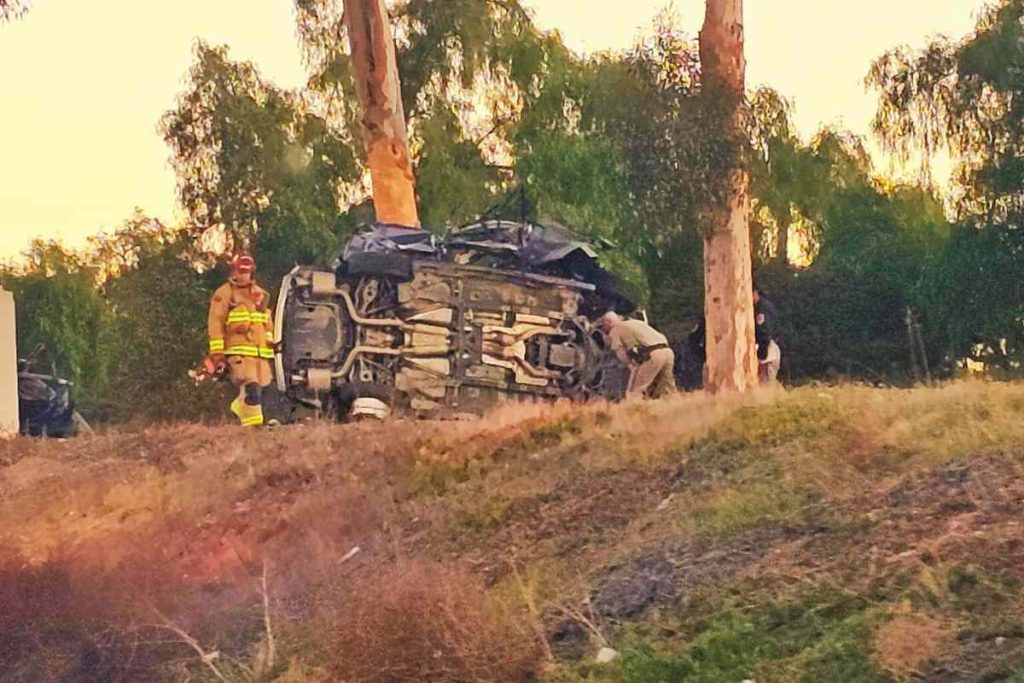
Questions about liability usually surface after the basics are understood but before anything feels settled. At this point, most people are trying to reconcile what they have heard with how California law actually works. The answers below focus on legal structure and process, not outcomes or shortcuts.
Who is at fault in a rear-end accident?
Yes, the trailing driver is often presumed at fault, but that presumption is not final.
California law starts from the assumption that drivers must maintain a safe following distance. That creates a default inference of fault in many rear-end collisions. However, this is only a starting point. Evidence showing sudden stops, mechanical failure, unsafe lane changes, or external hazards can shift or share responsibility. Fault is ultimately determined by how the facts align with the duty of reasonable care, not by the collision type alone.
Can both drivers be liable for the same accident?
Yes, California law allows shared liability.
California follows a pure comparative negligence system. That means more than one driver can be assigned a percentage of fault if their actions contributed to the collision. Liability is divided based on evidence showing how each driver’s conduct affected the outcome. Shared fault reduces recoverable damages proportionally, but it does not prevent liability from being assigned to more than one party.
Does a ticket decide who is legally at fault?
No, a traffic citation does not decide civil liability.
Tickets address alleged violations of traffic law. Civil liability focuses on whether a driver breached a duty of care and caused harm. While a citation may be considered as part of the evidence, it is not binding in a civil liability analysis. Fault determinations rely on a broader review of conduct, causation, and damages rather than enforcement actions alone.
What if the other driver has no insurance?
Lack of insurance affects payment sources, not fault analysis.
Whether a driver is insured does not change how fault is evaluated under California law. Liability is determined first, based on evidence and legal standards. If the at-fault driver lacks insurance, recovery may depend on other available coverage, such as uninsured motorist provisions, or may be limited by the absence of a viable payment source. The legal responsibility and the ability to collect are separate questions.
How long does fault determination usually take?
There is no fixed timeline for determining fault.
Fault assessment develops as evidence is gathered and reviewed. Straightforward collisions with clear documentation may be evaluated relatively quickly. Accidents involving disputed facts, multiple vehicles, or incomplete records often take longer because liability depends on resolving evidentiary gaps. California law sets no deadline for reaching a fault conclusion, and determinations often evolve as additional information becomes available.
What California Car Accident Liability Law Does Not Do
Before moving forward, it helps to clear away a few assumptions that often cause confusion. California car accident liability law sets boundaries. It defines what can be evaluated and what cannot. It does not promise outcomes, fill gaps, or resolve uncertainty on its own. Understanding these limits makes everything else in this process easier to interpret.
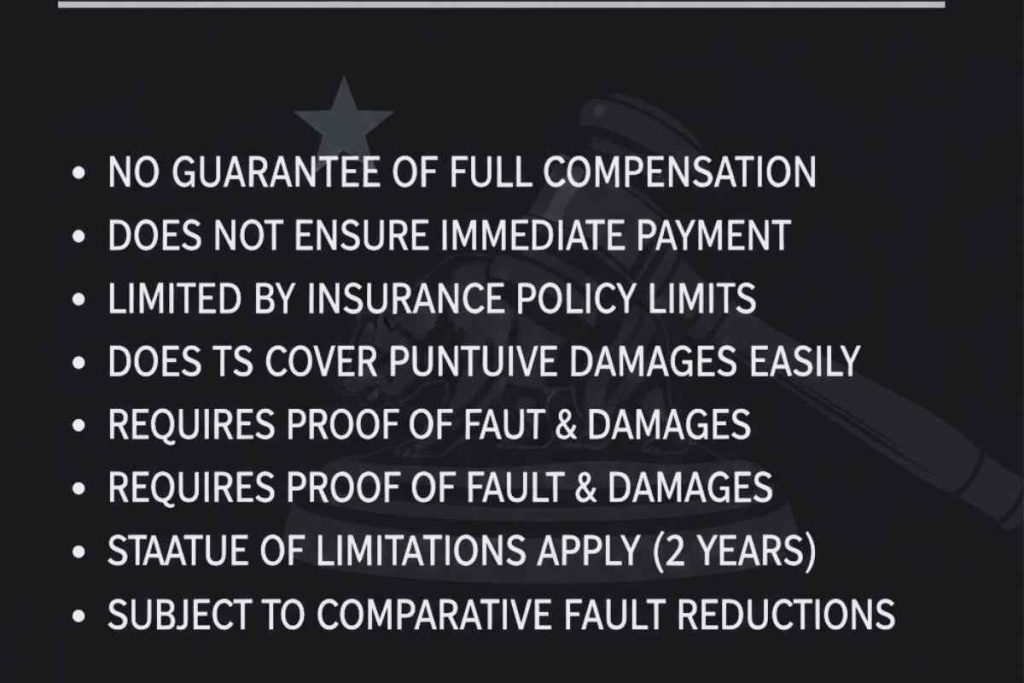
Here are three things California liability law does not do.
- No guaranteed compensation
California law does not promise payment simply because an accident occurred or an injury exists. Compensation depends on whether legal responsibility can be proven and whether there is a source of payment, such as insurance or assets. Even serious harm does not create automatic recovery without meeting legal standards. - No automatic fault assignment
Liability is not assigned by default. There is no automatic winner or loser based on who was hurt, who reported first, or who seems more sympathetic. Fault is evaluated through evidence, legal duties, and causation. Until that analysis happens, responsibility remains unresolved. - No insurance expansion
Liability law does not increase insurance coverage. It cannot raise policy limits, create coverage where none exists, or force an insurer to pay beyond contract terms. Legal responsibility and available insurance are related but separate questions, and the law does not merge them.
Misunderstanding these limits is one of the most common reasons liability disputes and settlement delays occur later in the process.
How This Liability Framework Fits Into California Personal Injury Law
Car accident liability does not exist as a standalone concept. It functions as the entry point into California’s broader personal injury system. Until liability is established, the rest of personal injury law does not activate in a meaningful way.
Under California law, personal injury claims are evaluated through a negligence framework. Car accidents are one application of that framework, not a separate category with different rules. The same legal test used to evaluate a freeway collision also applies to other injury claims, such as unsafe property conditions or preventable workplace incidents. What changes is the factual context, not the legal standard.
Liability answers a threshold question: whether another party can be held legally responsible for harm. Once that question is supported by evidence, the personal injury system determines how damages are assessed, how fault is allocated, and how compensation is evaluated within available insurance or assets. If liability cannot be established, the analysis stops, regardless of injury severity.
This is why liability disputes matter so much in car accident cases. They determine whether the personal injury framework applies at all, and if it does, how the rest of the claim is structured under California law.
Understanding Liability Before Making Decisions
Questions about liability often surface before anything else because they sit at the center of uncertainty. Who is legally responsible determines whether California’s personal injury framework applies at all. Until that question is grounded in evidence, everything else remains conditional.
Liability in a car accident is evaluated through documented facts, not assumptions or initial impressions. Statements made at the scene, traffic citations, or early insurance positions may influence the process, but they do not replace the legal analysis required under California law. What ultimately matters is how duty, conduct, causation, and harm connect when reviewed together.
Outcomes vary because facts vary. Two accidents that look similar on the surface can lead to different liability conclusions once evidence is examined. This is why early certainty is rare and why liability disputes persist even when injuries are clear.
Understanding how liability is determined does not resolve a claim on its own. It does something quieter but more useful. It gives structure to uncertainty. When the legal framework is clear, decisions tend to feel less reactive and more grounded in how California law actually works.